

Effective citizen development oversight combines proportional human review, deny-by-default risk controls, and shared technical standards, so IT gains visibility without freezing delivery. The goal is not more sign-offs. It is fewer, better-placed ones that catch real risk while everyone else keeps shipping.
TL;DR:
Human review should be proportional and connected to clear risk classifications, approval limits, and an inventory that denies unregistered applications from running.
Runtime controls such as approval evidence, expiration TTLs, tamper-proof logs, and tested kill-switches are necessary for effective oversight beyond policy.
Roll out governance gradually by inventorying automations, establishing a center of excellence, piloting full controls on high-risk automations, then scaling with continuous monitoring.
Key KPIs include time-to-production, security incidents, inventory coverage, and remediation times, with regular audits to detect process drift.
Orchard can help teams investigate software and AI usage and repeated work using available activity and evidence. Confirm required inventory, approval, and runtime controls separately during evaluation.
Table of Contents
-
Building the Governance Framework: Roles, Policies, and a Center of Excellence
-
What Do Runtime Human Oversight Controls Actually Look Like?
-
Orchard as a Practical Layer for Citizen Development Oversight
What Is Citizen Development, and Why Does Oversight Matter?
A citizen developer is a business employee, not a professional engineer, who builds apps, automations, or workflows using low-code platforms or RPA tools. Citizen development is the broader practice of letting these employees solve their own operational problems instead of waiting on a centralized IT queue.
The trend is accelerating for a practical reason: the supply of professional software developers hasn’t kept pace with demand, and low-code platforms, RPA, and AI agents now let non-engineers automate real work in days instead of quarters. Left ungoverned, that speed creates predictable damage:
-
Shadow IT: apps and bots nobody in security or IT even knows exist.
-
Data fragmentation: five departments building five incompatible versions of the same customer record.
-
Security gaps: hardcoded credentials, overprivileged connectors, exposed data flows.
-
Approval-prompt deception: automations that get rubber-stamped “yes” without anyone actually reading what they authorize.
Governed well, the upside is real. Forrester’s research on the citizen development business case links these programs to faster delivery and a smaller professional developer backlog, because the people closest to a workflow’s pain point are also the ones best positioned to fix it.
Building the Governance Framework: Roles, Policies, and a Center of Excellence
A Center of Excellence, or an equivalent steering group, is where citizen development governance lives day to day. Give it a narrow, explicit remit: risk classification, approval authority, tooling standards, and training. Give it a sponsor senior enough to say no to a business unit without triggering an escalation war.
From there, three policy building blocks do most of the work:
-
Risk classification. Not every spreadsheet macro deserves the same scrutiny as a bot that touches customer payment data. Tier by data sensitivity, system access, and business impact.
-
Approval matrix. Map each risk tier to a specific approver and a maximum review time, so nobody’s waiting on a decision that got lost in someone’s inbox.
-
Inventory and deny-by-default. Every citizen-built app or automation gets registered before it goes live. Unregistered means it doesn’t run.
On the technical side, Forbes Technology Council contributors argue that governance works best as a productivity service: a canonical data layer, a list of pre-approved connectors, and secure starter templates. That framing matters because Gartner’s guidance on adaptive data governance makes the same point from a different angle: rigid, one-size-fits-all rules push people toward workarounds, while flexible, risk-based standards keep them inside the guardrails voluntarily.
Pro Tip: Build your first three starter templates around the automations your help desk already fields the most complaints about. That’s where citizen developers will go first anyway.
Exception handling and delegated approval authority round out the operational side. Someone needs clear ownership of “what happens when a request doesn’t fit the matrix,” or that gray area becomes the biggest hole in the whole framework.
What Do Runtime Human Oversight Controls Actually Look Like?
Policy on paper doesn’t stop a bad automation at 2 a.m. Runtime controls do. Academic work on meaningful human oversight from AI and Ethics makes a sharp distinction here: an approval only counts if the reviewer had real “evaluative agency.” That means the interface has to show the resolved arguments an action will actually execute, which policy it’s being checked against, and a confidence score, not just a generic “Approve this action?” popup.
Four controls make that distinction operational:
-
Approval gates that surface substance, not summaries. A reviewer approving a payment automation should see the resolved recipient, amount, and account, not a vague description of the workflow’s purpose.
-
TTLs on approvals, with fail-closed defaults. An approval that expires after a limited time forces re-review instead of letting stale sign-offs quietly authorize new behavior. If the TTL lapses, the action stops, not runs.
-
Tamper-resistant audit trails. Every log entry needs identity, timestamp, prior state, resulting state, and a pointer to supporting evidence, ideally in an append-only store, per patterns outlined in OWASP’s human oversight research.
-
Kill-switches, tested on a schedule. A kill-switch nobody has exercised in six months is a kill-switch you can’t trust in an incident.
That last point connects to a known failure mode practitioners call approval-prompt deception, where a system technically asks for sign-off but frames the request so vaguely that approval becomes automatic. Deny-by-default inventory and time-bound exceptions are the direct countermeasure.
How to Roll Out Oversight Without Killing Momentum
Sequencing matters more than any single control. Roll these out in order, not all at once:
-
Discovery. Inventory every citizen-built app and automation already running, then classify each by risk tier.
-
Foundation. Stand up the CoE, write the core policies, and publish two or three starter templates with secure defaults baked in.
-
Pilot. Apply full runtime controls, approval gates, TTLs, audit logging, to one or two high-value automations. Measure what changes.
-
Scale. Extend delegated approval authority to trained business unit leads, build an automation catalog, and move to continuous monitoring instead of one-off reviews.
A few things make this move faster instead of slower:
-
Train business unit approvers before delegating authority to them, not after.
-
Reuse the discovery inventory as the seed for your ongoing automation catalog.
-
Treat the first pilot’s audit trail as the template for every one that follows.
Digital follows a similar sequence, and public-sector teams can find comparable examples through the Federal Automation Community of Practice.
Which KPIs Prove Your Oversight Program Is Working?
Governance that can’t show numbers eventually loses its budget. Track these on a monthly cadence, and audit a risk-weighted sample of inventoried apps quarterly rather than trying to review everything:
-
Time-to-production for a new citizen-built automation, from idea to live.
-
Security incident count tied to citizen-built tools.
-
Percentage of known apps and automations actually in the inventory.
-
Average remediation time once an issue is flagged.
Watch for drift signals: inventory percentage sliding downward, remediation times creeping up, or approvers rubber-stamping requests faster than they could plausibly be reading them. Any of those means it’s time to revisit training or tighten the approval matrix, not just log the incident and move on.
How Orchard’s Approach Maps to This Governance Playbook
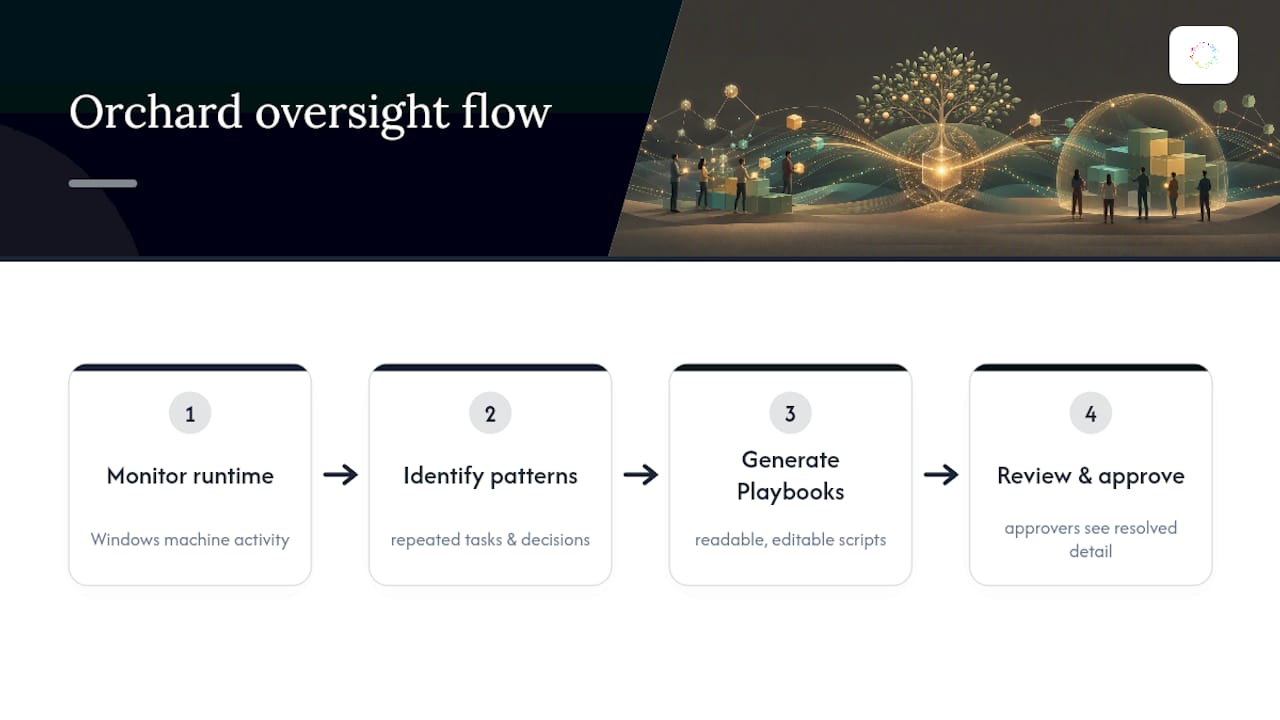
Orchard provides visibility into employee activity, software and AI usage, workload patterns, and workflow bottlenecks. This can inform conversations with process owners about repeated work and where more investigation is needed; it does not establish a complete inventory of citizen-built applications.
-
Isaac helps leaders investigate business questions using the activity and evidence available within the agreed scope.
-
Studio provides custom dashboards and views; required approval evidence and runtime enforcement should be validated in the systems responsible for executing the workflow.
-
Data handling and security practices are documented on Orchard’s Trust page for teams that need to verify before they deploy.
A Practical Starting Point for Oversight
Oversight fails when it’s built to say no. It works when it’s built to say yes, fast, to the right things. Start with inventory. Pilot one high-value automation with the full approval and audit flow. Learn from that before scaling.
— Katie
Orchard as a Practical Layer for Citizen Development Oversight
Begin with a maintained inventory of citizen-built applications and automations, named owners, and risk classifications. Orchard can contribute visibility into software usage and repeated work within its available scope, alongside the records maintained by IT and business teams.

Activity evidence is one input to oversight. Reconcile it with platform inventories and process-owner reviews, and test approval, access, and exception controls in the systems that enforce them. Avoid treating visibility alone as proof of complete coverage or compliance.
Request an Orchard briefing to discuss software and AI usage visibility for your team, and review the Trust page before agreeing on an evaluation scope.
Sources
For policy language and technical detail, start with the NIST AI RMF’s practical oversight guidance, OWASP’s Citizen Development risk list, and the Springer research on meaningful human oversight. For market context, see Forrester’s citizen development business case and public-sector examples from Digital.gov.
- Make the business case for citizen development